Scope of Application and Types of Eye Protection Equipment
This European standard specifies functional requirements for different types of personal eye protection equipment, as well as their marking. Three types are distinguished: safety spectacles with or without side protection, safety goggles, and face shields.
Applications of Eye and Face Protection
Augen- und Gesichtsschutz schützen, je nach ihren Eigenschaften, gegen
- Impacts of varying energy levels
- Dust
- Optical radiation
- Gases, molten metals, and hot solids
- Droplets and splashes
- Electric arcs
Requirements
General
Schutzbrillen dürfen keine Hautreizungen verursachen, keine vorspringenden Stellen, scharfe Kanten oder sonstige Fehler aufweisen, die voraussichtlich beim Tragen unbequem sind oder Verletzungen verursachen.
Marking
Ocular
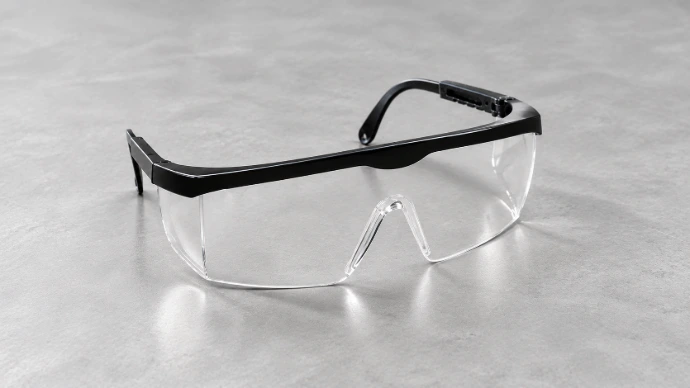
Eye protection equipment, such as our REF K204, must provide a minimum field of view. Based on their spherical, astigmatic, and prismatic refractive properties, oculars are divided into three optical classes¹. They must also be resistant to UV radiation.
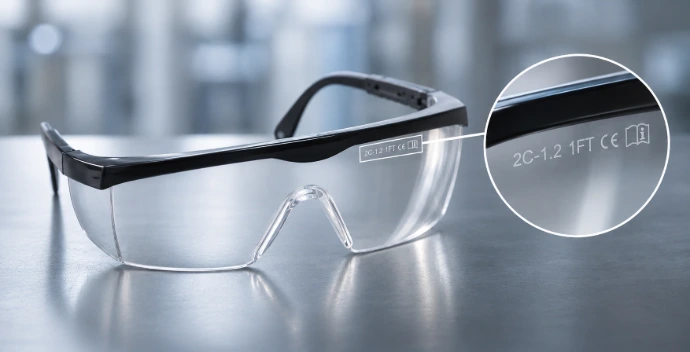
Oculars and frames must be marked separately unless they form a single unit. The marking must be clearly visible and permanent and must not impair the wearer's vision.
Structure of the Marking
Frame Marking
The frame marking includes the manufacturer's identification mark, the number of this standard, the fields of use, and the resistance properties.
Ocular Marking
Auf der Sichtscheibe werden zunächst das Herstellerkürzel, dann die optische Klasse, das Kurzzeichen für Nichthaften von Schmelzmetall und Beständigkeit gegen Durchdringen heißer Festkörper (falls zutreffend) und anschließend die Beständigkeit gegen Teilchen höherer Geschwindigkeit aufgeführt. Weitere Eigenschaften der Sichtscheibe sind an den letzten Ziffern erkennbar.
Optical Classes
Class 1: Suitable for tasks requiring particularly high visual performance (for continuous use).
Class 2: Suitable for tasks with moderate visual performance requirements.
Klasse 3: sollte nur in Ausnahmefällen, für grobe Arbeiten ohne größere Anforderungen an die Sehleistung, eingesetzt werden (nicht für den Dauergebrauch).(Quelle: BGR 192 (ZH 1/703)
Verwendungsbereiche von Augenschutzlösungen
The fields of use of eye protection equipment are identified by numerical markings. Code 3 indicates protection against liquids in the form of droplets and splashes, while code 4 refers to protection against dust particles larger than 5 µm. Code 5 covers gases, vapours, mists, smoke, and fine dust particles smaller than 5 µm. Code 6 indicates protection against radiant heat from infrared sources, and code 8 indicates protection against electrical arcs caused by short circuits in electrical installations. Code 9 indicates protection against splashes of molten metal and penetration by hot solids.
Resistance to High-Speed Particles
The mechanical resistance of eye protection equipment is classified into different protection levels. Basic mechanical strength is indicated without an additional marking. The marking S indicates increased mechanical strength, tested using a drop ball test with a 43 g steel ball. The marking F indicates protection against low-energy impacts at an impact velocity of 45 m/s, while B indicates protection against medium-energy impacts at 120 m/s. The highest level, A, indicates protection against high-energy impacts at 190 m/s. A 0.88 g steel ball is used for testing each of the F, B, and A protection levels.
Hier schreiben …