General
Whether in cold storage facilities, the food industry, or during outdoor work, low temperatures can put considerable strain on the hands and impair finger dexterity. However, not every cold protection glove is suitable for every application.
DIN EN 511 specifies the requirements and test methods for protective gloves against convective and contact cold down to −50 °C. Three performance levels indicate the protective properties of a glove.
What Does DIN EN 511 Mean?
The standard distinguishes between two types of cold exposure:
Convective cold: Heat loss caused by the surrounding cold air, particularly when the air is moving.
Contact cold: Heat loss caused by direct contact with cold objects or surfaces.
In addition, the gloves are tested to determine whether water penetrates within a specified test period. Moisture can reduce thermal insulation and cause the hands to lose heat more rapidly.
How Are Cold Protection Gloves Marked?
The level of protection is indicated by a cold protection pictogram with three performance ratings.
The level of protection is indicated by a cold protection pictogram with three performance ratings. The first number indicates resistance to convective cold, while the second indicates resistance to contact cold. Both properties are rated on a scale from 0 to 4, with 4 representing the highest level of protection. The third number indicates resistance to water penetration and is rated either 0 or 1.
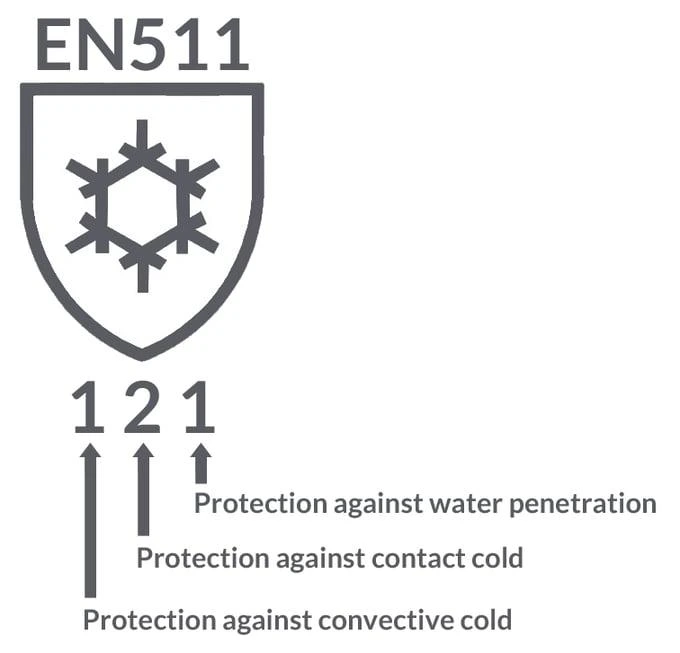
For both convective and contact cold, performance level 4 represents the highest tested level of protection. A rating of 0 indicates that the minimum requirements for level 1 have not been met. An X indicates that the test was not performed or is not applicable.
For water penetration, a rating of 0 indicates that water penetrates the glove during the 30-minute test. A rating of 1 indicates that no water penetration occurs within this test period.
DIN EN 511 also requires an appropriate level of mechanical resistance in accordance with EN 388. The specific combination of performance levels is indicated on the respective product.
Which Cold Protection Glove Is Right for You?
The key factor is the actual exposure to cold in the workplace:
Working in cold environments: Resistance to convective cold is particularly important in these conditions.
Handling cold objects: When handling chilled or frozen materials, resistance to contact cold is particularly important.
Wet working conditions: The tested resistance to water penetration should also be taken into account.
In addition to the level of protection, grip, finger dexterity, and wearing comfort also play an important role. The marking alone does not specify a universal minimum temperature at which a glove can be safely used for every task.
Reliable Hand Protection at Low Temperatures
Whether in cold storage logistics, food processing, or industrial applications, suitable cold protection gloves must be matched to both the ambient temperature and the specific task.
DACH Schutzbekleidung supports companies in selecting suitable protective gloves for different working conditions. The selection is based on the workplace risk assessment and the verified protective properties of the respective products.